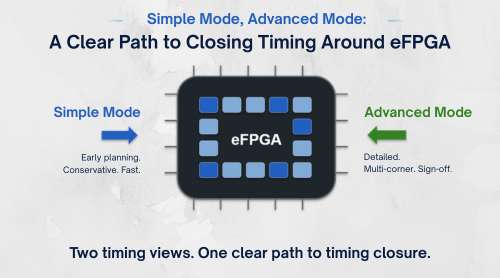
Verification Sanity in Chiplets & Edge AI: Avoid the “Second Design” Trap 

Reduce Complexity. Accelerate Tape-Out

As we gather at IP-SoC 2026, the industry consensus is clear: the monolithic SoC is no longer the only game in town. With the rise of chiplet-based architecture and Edge Generative AI, we are integrating more “black boxes” than ever. In this hyper-modular world, the “Second Design” problem isn’t just a nuisance. It’s a tape-out killer.  For embedded FPGA (eFPGA), the stakes are […]

Read More… from Verification Sanity in Chiplets & Edge AI: Avoid the “Second Design” Trap 

Bridging the Gap: Why eFPGA Integration is a Managed Reality, Not a Schedule Risk

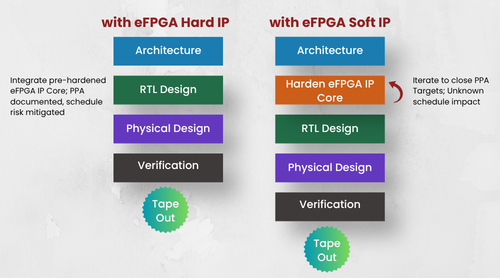
Side-by-side infographic comparing ASIC design flows using eFPGA Hard IP versus eFPGA Soft IP.

In the high-stakes world of aerospace and defense (A&D) microelectronics, the primary currency isn’t just performance—it’s predictability. When architecting a new ASIC, the specter of “unknown unknowns” is what keeps Program Managers awake at night. A common friction point in adopting embedded FPGA (eFPGA) technology is the perceived schedule risk associated with integration overhead. Critics […]

Read More… from Bridging the Gap: Why eFPGA Integration is a Managed Reality, Not a Schedule Risk

Tapeout Predictability with Hardened eFPGA IP Blocks

In the high-stakes world of modern SoC development, predictability is the ultimate currency. As design cycles shrink and the cost of a 5nm or 3nm mask set climbs into the tens of millions, the pressure to hit a tapeout date—and ensure first-pass silicon success—has never been higher. For architects, adding flexibility via embedded FPGA (eFPGA) […]

Read More… from Tapeout Predictability with Hardened eFPGA IP Blocks

Accreditation Without Compromise: Making eFPGA Assurable for Decades

Making eFPGA Assurable for Decades

In the world of defense acquisition, flexibility is often viewed with some skepticism. While the strategic value of updating an algorithm in theater without a hardware re-spin is undeniable, defense programs are built on the bedrock of assurance, predictability, and configuration control. When a program office asks, “Can we control the bitstream and toolchain over […]

Read More… from Accreditation Without Compromise: Making eFPGA Assurable for Decades

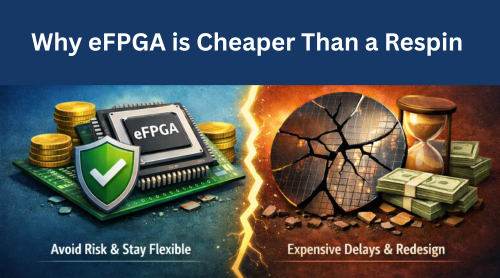
Silicon Insurance: Why eFPGA is Cheaper Than a Respin

Silicon Insurance: Why eFPGA is Cheaper Than a Respin

  This blog reframes the “flexibility vs. cost” debate in modern SoC design, positioning eFPGA not as a luxury feature, but as a critical financial hedge against the rising costs of advanced silicon nodes.  In the world of commercial silicon, flexibility is often treated like a high-end trim package on a luxury car: nice to have, but it […]

Read More… from Silicon Insurance: Why eFPGA is Cheaper Than a Respin

FPGAs vs. eFPGAs: Understanding the Key Differences

FPGAs vs eFPGAs

Summary: As chip architecture evolves toward heterogeneous SoCs and chiplets, engineers face a growing challenge: balancing flexibility with efficiency. Traditional FPGAs remain essential for rapid prototyping and field reconfigurability, but embedded FPGAs (eFPGAs) are increasingly becoming a smart choice for adding flexibility to ASIC and SoC devices. This article breaks down the key differences between […]

Read More… from FPGAs vs. eFPGAs: Understanding the Key Differences

Epson Achieves 50% Energy Efficiency with QuickLogic eFPGA

Epson Achieves 50% Energy Efficiency with QuickLogic eFPGA

First-Pass Success with QuickLogic eFPGA Hard IP on TSMC e12n At QuickLogic, we pride ourselves on helping customers solve their toughest design challenges with flexible, efficient, and silicon-proven eFPGA Hard IP. Recently, one of our customers announced its achievement of a major milestone that illustrates some of the benefits of implementing QuickLogic eFPGA Hard IP […]

Read More… from Epson Achieves 50% Energy Efficiency with QuickLogic eFPGA

2025 Year in Review: Design Wins, Advanced Nodes, and Expanding Markets

QuickLogic 2025 year in review

2025 marked a strong year of execution for QuickLogic, driven by customer wins across both its eFPGA Hard IP and device businesses, expansion into new end markets, and continued progress at advanced process nodes. Alongside growing adoption of eFPGA IP in defense, data center, edge, and space applications, the company made progress in the execution […]

Read More… from 2025 Year in Review: Design Wins, Advanced Nodes, and Expanding Markets

Smarter ASICs and SoCs: Unlocking Real-World Connectivity with eFPGA and Data Converters

Data converters are the gateways that connect the real (analog) world to the digital world. They are available as discrete devices, integrated into microcontrollers and FPGAs as well as licensable intellectual property (IP) in nearly all popular foundry process nodes.    With the explosion of AI processing at the edge and the rising cost of […]

Read More… from Smarter ASICs and SoCs: Unlocking Real-World Connectivity with eFPGA and Data Converters

A Look Back at a Year of Milestones and Momentum

As we’ve moved into 2025, I’m taking a moment to reflect on the past year and I am incredibly proud of the remarkable achievements and significant growth we experienced at QuickLogic in 2024. Last year, we solidified our position as a leader in innovative embedded FPGA (eFPGA) technology and expanded our reach across multiple sectors, […]

Read More… from A Look Back at a Year of Milestones and Momentum