ArcticLink III VX Solution Platform Family

The ArcticLink III VX Combines Display Bridging of LVDS, MIPI-DSI, and RGB with Visual Enhancement and Power Savings Technologies


Powered with DPO and VEE, the ArcticLink III VX solution platform family brings sunlight viewability to your mobile device

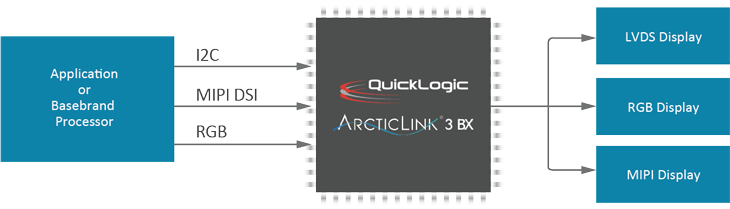
The ArcticLink III VX solution platform family combines Visual Enhancement Engine (VEE) and Display Power Optimizer (DPO) technologies with display bridge technology featuring LVDS, MIPI-DSI, and RGB interfaces. Among the 17 silicon variants are devices which allow the system designer to bridge a single interface to another, or to take a single MIPI-DSI input and convert that to two separate, distinct outputs of different standards. This highly integrated, yet flexible platform makes it the ideal solution for display and connectivity subsystems of handheld portable devices including smartphones and tablets.

Systems designers with the need to bridge display interfaces can also take advantage of the ArcticLink III VX’s on-board VEE and DPO technology for additional system performance. VEE dynamically adjusts the local contrast ratio and dynamic range of display content according to the viewer’s ambient light level; and unlike other machine-based enhancement technologies, VEE is based on a model of human eye, providing the most natural-looking viewing experience of any enhancement technology. Coupled with VEE, DPO technology allows the display brightness level to be set significantly lower without any negative affects to the viewing experience, regardless of content. DPO has been OEM-proven to save an average of 25% of system single-charge battery life, enabling OEMs to extend battery life of their devices significantly without the added cost, size, and weight of larger capacity batteries.

  • VEE enables superior viewability of OLED, AMOLED, LCD, and SuperLCD displays even in the toughest of viewing environments, including bright sunlight
  • DPO significantly reduces system power consumption through intelligent control of display brightness
  • MIPI-DSI, LVDS, and RGB inputs and outputs in 17 unique bridging, pass-through, or dual output variants


ArcticLink III VX (CSSP AL3VX) System Architecture

 ArcticLink III VX Solution Platform Family

Platform Input Output Application Maximum Resolution Size
VX3 MIPI-2
MIPI-4
MIPI-2
MIPI-3
MIPI-4
Smartphones, Tablets needing a
MIPI-2 to MIPI-4 bridge


Up to WUXGA
(1920 x 1200 pixels)
at 60 frames-per-second


4.5mm x 4.5mm
VX5AxB RGB MIPI Smartphones, Tablets needing a RGB to MIPI bridge
VX5AxD RGB LVDS Tablets needing a RGB to LVDS bridge
VX5BxA
MIPI RGB Smartphones, Tablets needing a MIPI to RGB bridge
VX5BxD MIPI LVDS Tablets needing a MIPI to LVDS bridge
VX6BxE MIPI MIPI & RGB Smartphones with need to drive either
HDMI/MHL transmitter or pico projector through a
MIPI to MIPI & RGB bridge
VX6BxG MIPI LVDS & RGB Smartphones and tablets with secondary
MHL/HDMI output requirement through a
MIPI to LVDS & RGB bridge
VX6BxH MIPI MIPI & LVDS Smartphones and tablets with secondary
MHL/HDMI output requirement through a
MIPI to MIPI & LVDS bridge


Display Enhancement Technologies — DPO and VEE

Displays are the largest single consumer of power in a typical smartphone or tablet design. While there are numerous ways to reduce display power consumption (such as Content Adaptive Backlight Control [CABC] or ambient light correction), each method reduces display viewability, often resulting in a poor user experience. QuickLogic’s VEE and DPO’s approach to display enhancement and power savings is a radical advancement from these previous technologies. In the analysis of every pixels, VEE examines the content of:

  • neighboring pixels
  • a sub-region of 1/8th of the whole frame
  • the entire frame

VEE uses that information to adjust contrast ratio, dynamic range and color values of the individual pixels, while DPO adjusts display brightness to save system power while maintaining the viewing experience. The ability to provide a unique tone curve for each pixel, as well as having tighter control over the display brightness, gives greater flexibility than the global adjustment performed by CABC. This approach results in greater power savings and the entirely new capability of adapting to a bright environment. VEE and DPO have been OEM-proven to save an average of 25% system power, with as much as 41% of system power.

Additionally, the ArcticLink III VX also integrates QuickLogic’s Intelligent Brightness Control (IBC) technology, which allows for even greater power savings. When display content is of lower contrast or dynamic range, such as streamed movies from YouTube, display brightness is further reduced without affecting the viewing experience. The IBC function adds up to an additional 10% in system power savings (content-dependent) on top of DPO’s already impressive savings.


Real World Power Savings

(Actual results depend on implementation)

Using QuickLogic's Intelligent Brightness Control (IBC) technology, an additional 10% in power saving is possible.

Family Overview

 
Silicon Variants 3 8 6
Contains
Supported Resolution

From QVGA (320x240) up to WUXGA (1920x1200)

From QVGA (320x240) up to WUXGA (1920x1200)

From QVGA (320x240) up to WUXGA (1920x1200)

Application
  • Smartphones with Pico projector
  • Tablets with Pico projector
  • Smartphones with a MIPI processor and display, and a need for RGB for an MHL/HDMI transmitter
  • Tablets with a MIPI processor, an LVDS display, and a need for RGB for an MHL/HDMI transmitter
Platforms

Mobile processor with MIPI interface

Mobile processor with an MIPI or RGB display output and a MIPI, RGB, or LVDS-enabled mobile display

Mobile processor with MIPI interface and a Pico projector or secondary MHL/HDMI output

Family Data Sheet ArcticLink III VX Solution Platform Data Sheet

Learn more about VX3

Learn more about VX5 Learn more about VX6

If you have questions for our solution experts, please contact us using the form below.